

A little garlic story to get you in the mood.
Why 40 Cloves Is a Cop-Out for Amateurs
We need to talk about the arbitrary limits society places on garlic consumption. You see these classic French recipes calling for “40 cloves of garlic chicken” as if forty is the absolute ceiling of culinary bravery. They treat it like the sound barrier, whispering that if you cross it, your kitchen will implode or your guests will evaporate into a cloud of pungent dust. I am here to tell you that forty is merely the warm-up. Forty is what you put in the mashed potatoes on a Tuesday when you are feeling a bit under the weather. For a celebration as grand as Eid, where the table groans under the weight of history and hospitality, we do not stop at forty. We triple digits.
This recipe was born out of a desire to silence the critics at my family table, specifically my Uncle Walid. He is a man who believes he has tasted everything, done everything, and that nothing produced by the younger generation can possibly compare to the roasted meats of the 1970s. I took this as a personal challenge. The goal was not just to roast a lamb; it was to create an allium singularity, a dish so intense, so sweet, and so savoury that it would force an emotional breakthrough. And to do that, I needed garlic. Lots of it. One hundred cloves, to be precise. It sounds like madness, but there is a method here. When you cook this much garlic slowly, submerged in fat and meat juices, it loses its aggressive bite and transforms into a nutty, caramelised paste that is closer to meat butter than a vegetable.
If you are reading this and thinking about reducing the amount, stop right there. This is a 100 clove garlic lamb for a reason. Reducing the garlic is like buying a sports car and pushing it down the driveway in neutral. You are missing the entire point of the exercise. We are building a flavour profile that relies on the sheer volume of bulbs to create a sauce that thickens itself. The garlic isn't a garnish here; it is a vegetable side dish in its own right, roasted until it yields to the slightest pressure of a fork. Buckle up, Tribe. We are going in deep.
Sourcing the Meat and the Mountain of Bulbs
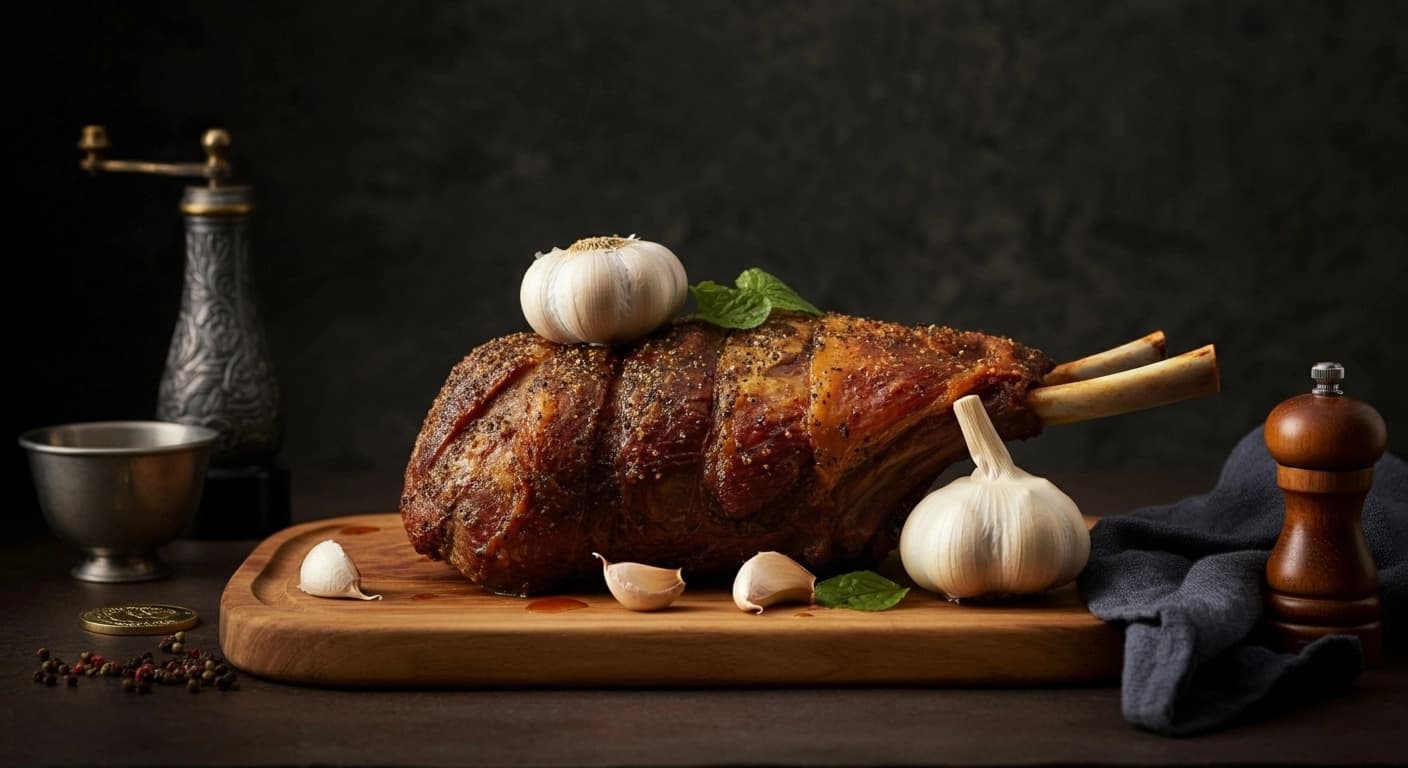
The foundation of this dish is, naturally, the lamb itself. You cannot hide bad meat behind one hundred cloves of garlic, although I suppose you could try if you were desperate. For this specific recipe, I always advocate for the shoulder over the leg. The shoulder has more fat, more connective tissue, and handles the long, slow abuse of the oven far better than the leaner leg. We want the meat to fall apart, to surrender completely to the garlic bath. You want a piece of meat that looks like it could survive a wrestling match, bone-in, with a decent cap of fat on top. That fat is going to render down and confit our garlic cloves, so do not trim it away like you are afraid of flavour.
Then comes the garlic acquisition. Do not embarrass yourself by buying those tiny little net bags with three sad bulbs rattling around inside. You need to go to the market and buy a proper braid or a loose kilo. When selecting your bulbs, look for tight, papery skins and firm cloves. If they feel soft or hollow, they are dehydrated and will burn rather than caramelise. You are going to need roughly eight to ten whole heads of garlic depending on their size. Yes, the cashier will look at you funny. Yes, they might ask if you are planning to ward off an entire army of vampires. Just smile, nod, and maybe breathe on them a little bit to assert dominance.
A note on variety: if you can find the purple-striped garlic, grab it. It tends to be slightly sweeter when roasted and holds its shape better than the stark white variety. However, standard white garlic works perfectly fine. The magic here is in the quantity and the cooking time, not necessarily in sourcing a rare heirloom variety grown by monks on a hillside. We are cooking for a feast, not a museum exhibition. The most important thing is that you have enough. If you think you have enough, buy two more heads just in case. There is no such thing as leftover garlic in this house.
The Prep: A Test of Patience and Finger Strength
I will not lie to you; peeling one hundred cloves of garlic is a chore. It is the kind of repetitive manual labour that makes you question your life choices about halfway through. But this is the price of admission for greatness. You can try the jar-shaking method, where you smash the bulbs and shake them violently in two metal bowls, but I find that only works for about 60% of the cloves. The rest still require hand-peeling. I suggest conscripting family members. Tell them it is a bonding activity. Put on some music, pour a drink, and get everyone working. It’s Eid, after all; communal suffering in the kitchen is part of the tradition.
Once the garlic is peeled, do not crush it. Leave the cloves whole. This is crucial. Crushed garlic burns instantly in a long roast and turns bitter. Whole cloves, protected by their own structure, will slowly soften and sweeten. We are essentially making garlic confit in the lamb fat. You want them to look like little jewels of ivory scattered around the meat. While your minions are peeling, you need to prepare the marinade for the lamb. This needs to be bold enough to stand up to the garlic. I use a mix of pomegranate molasses, olive oil, cumin, coriander, and yes, a little bit of crushed garlic (about 5 cloves, which doesn’t count towards the 100) to rub into the meat itself.
Take a sharp knife and stab the lamb all over. I mean really go for it. You want deep pockets where the marinade can penetrate. Shove a few of the whole cloves deep into these incisions, like flavour shrapnel waiting to detonate. The rest of the cloves will form a bed for the lamb to rest on, and a blanket to cover it. It should look ridiculous. It should look like you have made a mistake. That is how you know you are doing it right. If you look at the roasting tray and think, “That seems reasonable,” you have failed. Add more.
The Slow Roast Ritual
Cooking this beast is not a sprint; it is a marathon. We are looking at low temperature for a long time. Preheat your oven to roughly 150“C (fan). Cover the roasting tray tightly with foil. And I mean tightly. We want to steam the lamb in its own juices and the garlic vapours for the first four hours. If the steam escapes, the garlic dries out and becomes chewy, and the lamb gets tough. Seal it like you are trying to contain nuclear waste. Place it in the oven and walk away. Do not open the door. Do not peek. Just let the alchemy happen.
Around hour three, the smell will hit. It starts as a subtle savoury note, then builds into a tsunami of roasting meat and sweet allium that will penetrate every porous surface in your home. This is the point where the neighbours might start sniffing around the fence. It is a scent that triggers primal hunger. It’s the smell of safety, of feast, of abundance. It is heavy, rich, and deeply comforting. If you have guests coming over, this smell is the best appetiser you could possibly serve. It sets the expectation that something momentous is occurring in the kitchen.
After four or five hours, depending on the size of your shoulder, take the tray out and remove the foil. The meat should be pulling away from the bone. The garlic cloves will be soft and golden, swimming in a pool of rendered fat and juices. Now, crank the heat up to 220“C. We want to blast the skin and get some char on those top cloves. Baste everything generously with the pan juices. Give it 20 to 30 minutes uncovered. You want the exterior to be dark, sticky, and crisp, providing a textural contrast to the meltingly soft interior. Watch it like a hawk during this phase; burnt garlic is bitter garlic, and we have come too far to ruin it now.
The Uncle Weeping Incident
Now, let us return to Uncle Walid. When I brought the tray to the table, the silence was immediate. The lamb was glistening, dark as mahogany, surrounded by a sea of what looked like golden nuggets. I pulled the bone out with two fingers—it slid out clean, no knife required. That is the first sign of victory. I began to shred the meat, mixing it with the roasted cloves, which instantly dissolved into a creamy, savoury jam, coating every strand of lamb in liquid gold. I served him a plate. He looked at the pile of meat, skeptical as always, and took a bite.
He chewed. He stopped. He closed his eyes. I saw his throat work as he swallowed. He took a piece of flatbread, scooped up a smear of the 100-clove sauce, and ate it pure. That is when I saw it. A single tear tracking through the wrinkles of his cheek. It wasn’t sadness. It wasn’t pain. It was the overwhelming realization that he had been wrong to doubt the power of the bulb. The sweetness of the garlic had balanced the gamey richness of the lamb so perfectly that his brain simply short-circuited. He looked at me, wiped his eye, and said, “Luciana, you are dangerous.”
That was the highest compliment he could give. The 100 clove garlic lamb didn’t just feed the family; it reset the hierarchy. It proved that excess, when handled with patience and technique, is a virtue. So, this Eid, or for any feast where you need to make a statement, do not be timid. Peel the cloves. Cry the tears. Roast the beast. And watch the toughest critics in your life crumble before the power of the Tribe. Now, go buy all the garlic in the shop before I get there.